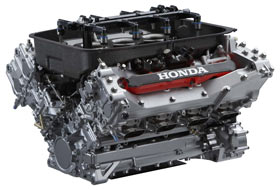
 F1 has went through numerous rules changes regarding engines, but the present rules are as follows. The engine can displace a maximum of 2.4L and can have a maximum of 8 cylinders, which must be arranged in a V-shape with an angle of 90 degrees. The maximum number of valves per cylinder is four and variable value timing and/or lift is banned. Forced induction (superchargers or turbos) are banned, meaning all of the engines are naturally aspirated. At right is the 2007 Honda V8.
 Displacement is very closely related to torque, and since displacement is capped at 2.4L, it is difficult to increase torque. Therefore the way to get more power out of the engine is to rev it higher. In the past F1 engines have rev'ed up to 21,000 rpm but now they are capped at 19k rpm. At right is a BMW V10 3.0L from 2005.
 F1 engines are known to make about 750 hp at 19k. From our formula above, that means the engines only make about 207 ft-lbs of torque at 19k, which is quite pedestrian. Only by spinning the engine very fast are they able to generate so much horsepower. By comparison, the LS7 engine (at right) in the new Z06 Corvette makes 475 ft-lbs at 4.8k and 505 hp at 6.2k, near its redline. If the LS7 engine was able to spin to a 19k redline, it would make around 1700 hp!
 However, increasing the redline of an engine is not easy. During every revolution of the crankshaft each piston is taken to the top and bottom of its travel twice. This means the piston is changing directions four times per revolution. Each direction change puts stress on the components of the engine, as the piston is accelerating from 0-60 mph in 3 ten-thousandths of a second. The pistons accelerate at a maximum of 10,000 g's, and exerts 3 tons of force on the connecting rod! Therefore F1 engines have very light pistons and rods to minimize this stress. This picture shows the internals of the 2007 Renault V8. The connecting rods (the dark gray bars between the pistons and the crank) are very short compared to a production car engine. We'll talk in more detail about the engine internals later.
The valves of an engine are held closed by valve springs. When the cam turns, its lobe pushes the valve down against the spring and as the lobe passes the valve, the spring pushes the valve back up to close it. This works well until you reach very high redlines at which point something called 'hysteresis' happens to the valve spring. Basically the spring can't push the valve closed fast enough and the valve 'floats', unable to completely close before its opened by the cam again. This is bad.
 So some engineers at Renault's F1 team came up with a solution: use pneumatics in place of valve springs. Pneumatics use air to move things and therefore do not suffer from hysteresis. Pressurized nitrogen is used in the F1 engines to push the valves back up. This allows for reliable valve operation well past 21k rpms. MotoGP motorcycles are the only other form of racing to use pneumatic valves.
In F1, you must qualify and race the same engine in two consecutive races. This rule was designed to control costs so that the teams did not build 'grenade' engines that would only last 1 qualifying session or one race. In practice, teams are free to run of their engines and change at any time. If your designated race engine blows up in its first qualifying or first race, you must take a 10-spot grid penalty for the next race.
 The engine is also a structural (or 'stressed') member of the car. This means that the engine literally holds the rear of the car to the monocoque! The front of the engine is bolted to the rear bulkhead of the monocoque, and the rear of the engine is bolted to the transmission. The rear suspension is mounted to the transmission (also a stressed member). Lotus was one of the first teams to embrace this concept, as you can see here on their 1967 car.
 Using the engine and transmission as stressed members allows the monocoque to be shorter and eliminates extra weight. This is in stark contrast to a NASCAR car in which the engine and transmission are mounted within a tube frame, and the suspension members and bodywork are bolted to this frame.


No comments:
Post a Comment